CGMs for People Without Diabetes: What They Show and Who They Help
What a glucose sensor shows if you don't have diabetes, what normal readings look like in research, what the evidence says, and when a short trial may help.
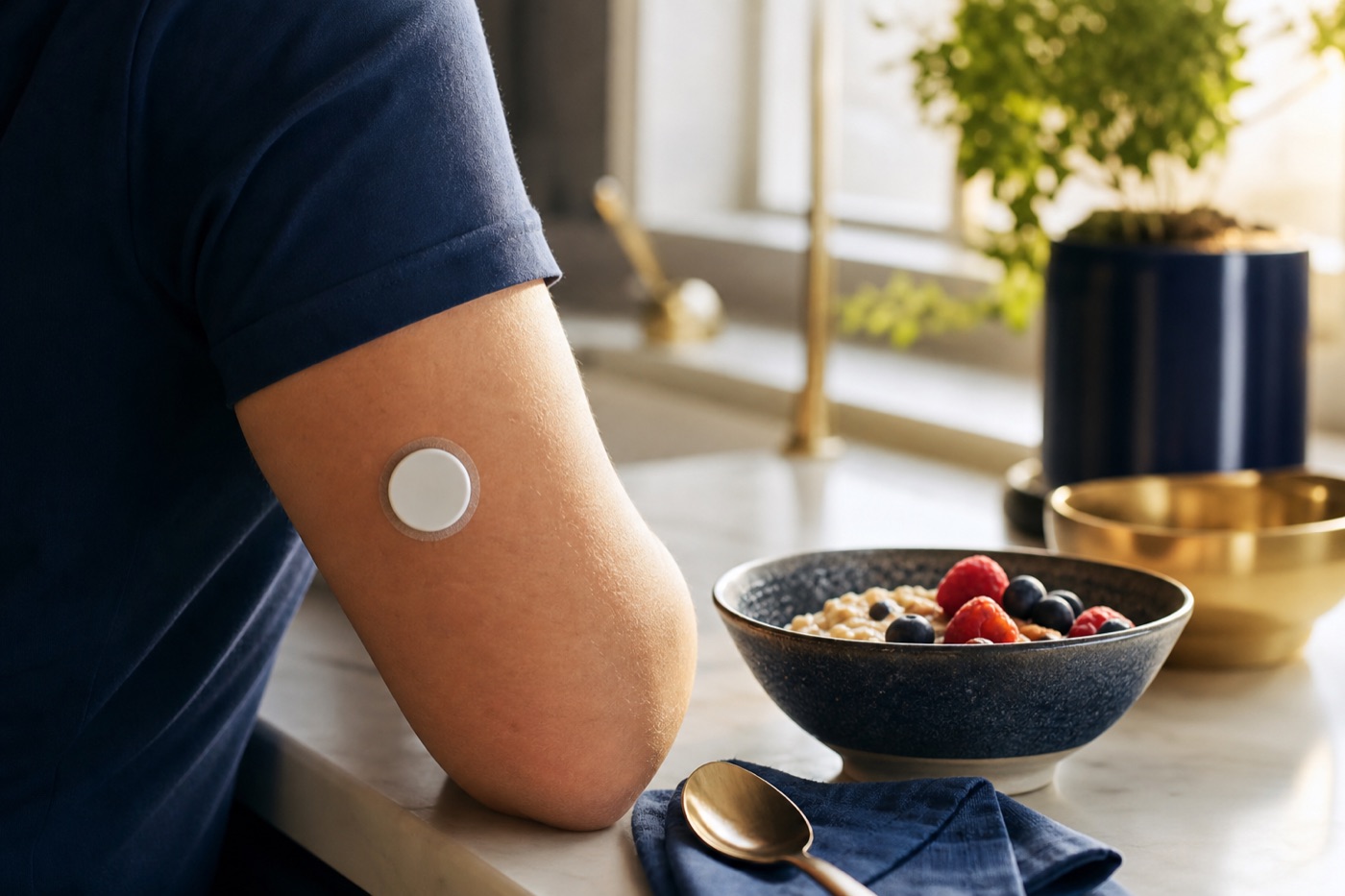
For someone without diabetes, a continuous glucose monitor shows how blood sugar rises and settles around meals, exercise and sleep, which can be interesting and occasionally motivating. What it has not shown, so far, is a health benefit: Harvard Health found no solid evidence that wearing one helps people without diabetes, and a 2026 JAMA Internal Medicine review found only limited, indirect evidence even for people with prediabetes or obesity. A short trial makes the most sense for the curious, or for someone working with a doctor on diabetes risk.
What the sensor is reading
A CGM is a small sensor inserted under the skin, often on the belly or arm, that reads glucose in the fluid between your cells, according to the National Institute of Diabetes and Digestive and Kidney Diseases (NIDDK). That level is “very similar to the glucose level in your blood,” NIDDK says. The device estimates your glucose every few minutes and a transmitter sends the readings wirelessly to a phone app or receiver.
Because the sensor samples that fluid rather than blood, it is an estimate. NIDDK notes that some models must be calibrated with a finger prick, and that comparing against a standard blood glucose meter settles doubts about accuracy. For a healthy person, the practical meaning is simple: look at the shape of the day, not at any one number.
In the US, these devices needed a prescription until 2024. That changed when the FDA cleared Dexcom’s Stelo as the first over-the-counter CGM and named, among its intended users, people without diabetes who want to understand how diet and exercise affect their blood sugar.
What typical numbers look like
The best-known benchmark comes from a multicenter study published in 2019 in the Journal of Clinical Endocrinology & Metabolism. Researchers fitted 153 healthy, nondiabetic children and adults, aged 7 to 80, with blinded Dexcom G6 sensors for up to 10 days. Key results:
- Average glucose: 98 to 99 mg/dL in most age groups; 104 mg/dL in participants 60 and older.
- Time between 70 and 140 mg/dL: a median of 96% of the day.
- Time above 140 mg/dL: a median of 2.1%, or roughly 30 minutes a day.
- Time below 70 mg/dL: a median of 1.1%, or about 15 minutes a day.
The lesson for first-time wearers is that healthy people do see brief climbs after meals and short dips, and both are part of the normal picture.
What the evidence says about benefit
Harvard Health Publishing reviewed the question in August 2024 and concluded there is “no solid evidence” that CGMs help people who don’t have diabetes. Its editor suggested the devices may prove useful for some people with risk factors, such as prediabetes, excess weight or a family history of diabetes, while stressing that this still needs to be shown in research before the devices are worth using for that purpose or likely to be covered by insurance.
A 2026 narrative review in JAMA Internal Medicine, by researchers including Victor Montori and Kasia Lipska, reached a similar place. The authors found only “limited and indirect evidence” for CGM in people with prediabetes or obesity, and concluded the technology should be used in response to a specific patient problem rather than as a default. They also called for avoiding overuse in groups where benefit remains unproven.
Absence of evidence is not proof of harm. It does mean the strongest case for a healthy person is personal curiosity, not prevention.
Who might reasonably try one
Some situations make a trial easier to justify:
- You’ve been told your risk is rising. If a doctor has flagged prediabetes, a sensor can make the effect of meals and walks visible, which some people find motivating. Bring the data to your next appointment rather than acting on it alone.
- You want to see your own patterns. People who are simply curious about how a late dinner or a morning run shows up can learn a lot from a single two-week sensor.
- You’re working with a dietitian. A clinician can help you read the curves in context instead of guessing at what each bump means.
If a doctor has diagnosed diabetes, the calculus is different, and the decision about which monitor to use belongs with your care team.
Ways the numbers can mislead
The easiest trap is treating ordinary rises as a problem. The Shah study shows healthy people spend some time above 140 mg/dL. Before you start restricting foods to flatten a curve, note that Abbott itself advises talking to a healthcare professional before changing diet or exercise, or if you have a current or past eating disorder.
There are physical effects too. The FDA listed local infection, skin irritation, and pain or discomfort among the adverse events reported with Stelo.
Finally, avoid gadgets that promise glucose readings without a sensor in the skin. In February 2024 the FDA told consumers not to buy or use smartwatches or smart rings that claim to measure blood glucose, because it has not authorized any of them to do so.
Getting one without a prescription
Two over-the-counter sensors are sold in the US: Dexcom Stelo and Abbott Lingo. Both are for adults 18 and older who don’t use insulin, and Abbott spells out that Lingo is not meant to diagnose diabetes. Stelo leans toward people managing type 2 diabetes with pills, while Lingo is framed purely around wellness. Dexcom adds that Stelo is not for anyone with problematic hypoglycemia, and both makers describe their sensors as HSA/FSA eligible, which can soften the cost of a trial. Our Lingo vs. Stelo comparison walks through wear time, apps and buying options, and the Best Glucose Monitors of 2026 page covers both alongside prescription devices.
The honest takeaway
A CGM can turn something invisible into a graph you can learn from, and for a curious person that may be worth one sensor. Go in knowing that research has not shown it makes healthy people healthier, that normal includes some peaks, and that any reading that worries you is a reason to call a doctor, not to self-diagnose.
Questions people ask
What is a normal glucose reading on a CGM if I don't have diabetes?
In a 2019 study of 153 healthy volunteers wearing blinded sensors, average glucose ran about 98 to 99 mg/dL for most age groups and 104 mg/dL in people over 60. Participants spent a median of 96% of the day between 70 and 140 mg/dL and about 30 minutes a day above that range.
Can a CGM diagnose prediabetes?
No. Abbott says its Lingo sensor is not intended to diagnose any disease, and the CDC notes that a blood sugar test is how prediabetes is identified. If you're worried about your risk, ask your doctor about testing.
Are there smartwatches that measure glucose without a needle?
The FDA says it has not authorized, cleared or approved any smartwatch or smart ring that measures blood glucose on its own, and it has warned consumers not to buy or use ones that claim to. Watches that display readings from an FDA-authorized CGM are a different matter.
How long should a curious person wear one?
There is no evidence-based answer for people without diabetes. Abbott sells Lingo in a two-week plan with a single sensor, a low-commitment way to try one and then judge whether the information changed anything you actually do.
Sources
- NIDDK: Continuous Glucose Monitoring
- Journal of Clinical Endocrinology & Metabolism: CGM profiles in healthy nondiabetic participants (Shah et al., 2019)
- Harvard Health Publishing: Should I use a continuous glucose monitor?
- JAMA Internal Medicine: Continuous Glucose Monitoring in Type 2 Diabetes and Beyond (2026)
- FDA: Do Not Use Smartwatches or Smart Rings to Measure Blood Glucose Levels
Guides are written by the Innovation Prizes editors from makers' documentation, regulators and published research. We do not take advertising or affiliate commissions. About us.